Wunberg Produce LLC
Vendor
Wunberg Produce LLC is co-owned and operated by Kenneth Wundrow and Robert Wesenberg. Combine the last names, and you get “Wunberg”. Our logo is inspired by Ken’s love for pugs and his dad’s overalls, drawn by a longtime artist friend, Bill Nelson, who lives in New York City. We are a berry farm and canning company.
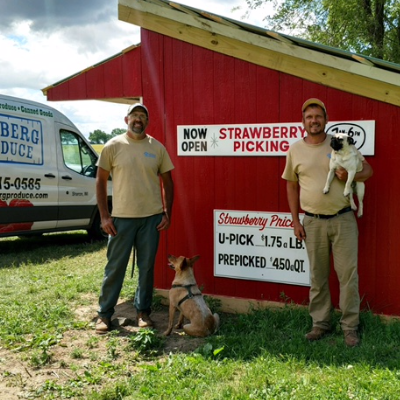
This adventure began in Winter 2014 when I sat down at Rob’s kitchen table at his dairy farm in Fort Atkinson and made a sketch of berry rows from measurements and notes after surveying an acre of land at my dad’s on State Line RD. Rob agreed to buy the plants and my dad agreed to rent to me, saying “this better not turn into a big patch like your gardens when you were a kid”. Rob and I decided to plant strawberries, asparagus, black and red raspberries, pumpkins, and some fruit trees. We converted this old corn field into a berry patch all by hand and with no special machinery. We waited a year for our first product to sell and were rewarded with strawberries in June of 2015. We never imagined what demand and interest would result from this project. Our success lead us to purchase a 25-acre farm on 9219 Lake Shore RD—north of Sharon, Wisconsin. In the years to come, we plan to have a full-fledged 25-acre berry farm and orchard with a country store. Products will include whole foods, dried herbs, vegetables, jams, honey, maple syrup and jellies, a petting zoo, and countless other products and attractions.
Perennial Crops Free Range Pastured Holistic Management Cover Crops Crop Rotation Low Till 100 Percent Grass Fed
We are NOT certified organic but strive to use many “organic” principles. To be what has been deemed certified organic by regulators are principles that are highly subjective and in my mind and are NOT truly “organic” by my standards…In some cases dictates the type of tractor that is used. I will tell you that much of what is labeled organic is not “organic” by my personal philosophy. Our goal is to be 100% transparent in everything we do. For example, I have seen sickly animals that suffer due to inaction to provide medicine because the organic rules don’t allow treatment. I will NOT watch an animal or person die or suffer due to lack of medical care. I have seen organic growers that had to apply herbicide or pesticides as a rescue to save a crop and are allowed to stay certified organic due to stipulations of “organic” law. I use TONS of compost, manure, wood chips, and pine needles. I have no control knowing whether the animal that produced this manure was organic or was the tree organic that became the wood chips. Even certified organic growers are not as “organic” as sometimes assumed. Plants require a variety of nutrients that become depleted in time. Soil testing has to be done to maintain certain nutrient requirements. As needed certain nutrients need to be added. This is done with natural additives (nitrogen, calcium, phosphorous, and potassium) always following manufacturer instructions never at times of production or harvest. Blueberries will NOT grow without some elemental sulfur. ome plants are heavy nutrient feeders which mean they need very nutrient rich soils such as pumpkins, squash, and rhubarb.
We are NOT conventional either. I struggle with which word I will say we are. Fancy words are used all the time in marketing and presentation of food products. We will state what we do and let our consumers decided for themselves. I believe our quality speaks for itself. We avoid pesticides and herbicides 90% of the time. By following educated good practices, it is usually not necessary to use conventional pesticides and herbicides. Sometimes the use of mild, safe herbicides is necessary for weed control during non-productive times and around perimeters of fields with no direct contact with plants (round up). We do minimal tillage…this is a huge management program. Rob has always been a firm believer of “no till farming”. These practices reduce irrigation needs, eliminate runoff and erosion, and need for herbicides to control weeds because of natural organic litter and “green manure". These practices encourage the natural organic processes of the soil and encourage worms and all of nature’s bacteria and microorganisms that work naturally in the soil. Once you stay consistent over a period of time you eliminate the weed seed “bank” naturally. Most of this can be achieved through minimal tillage. We employ regular help to do hand weeding. Use of pesticides would kill bees that are necessary for pollination and production of our natural honey. At the same time, fall raspberries are full of bugs if certain steps are not taken. Only once in three years, a pesticide (pyrethroid based derived from flowers that occur in nature) was sprayed around perimeter with no direct contact with fruit or blossom. It is a fine line I take very seriously. I always follow label instruction and it is always done to the bare minimum. Rob holds a certified applicators license which was required when he cash cropped. With GOOD basic care of plants and animals that have been instilled in Rob and myself in our years in agriculture, it is SURPRISING that conventional herbicides and pesticides are USUALLY not required. Keeping plants pruned and proper spacing for adequate air flow eliminates fungal growth and other potential pests. We recycle as much as possible including the jars. Labeling requirements on jars are making it harder and harder to recycle. Sometimes a law with a good intention can make it more difficult to be as environmentally friendly as desired. It really comes down to common sense and transparency. Education is critical on our end and that our consumers get the facts so that they can make sound judgments.
The smells and sounds of spring…. The heat and abundance of summer…The color and crispness of fall…The tranquility and quiet of winter…This is the backdrop of farming.
When the first sunny days of late April arrive and the robins are pulling worms and chirping, the fruit trees are in full bloom releasing pent up fragrance, and the cattle are frolicking in bright lush green pasture loaded with yellow dandelions, there is no OTHER place I would rather be. The thrill of excitement seeing the first spear of asparagus poking from the cool damp earth and the mother duck presenting her newly hatched brood. This is my paradise. I would rather be nowhere else. While some of my friends take vacations to exotic places, I am content with my paradise and don’t miss the steel and glass towers of the big cities I once worked. However, I treasure ALL my experiences and use them all to make Wunberg Produce successful and to contribute to my community.
Rob turned down scholarships for 4-year degrees in Chemistry and chose to stay farming after high school and never had any regrets.
Rob and I both come from multiple generations of farming families on both maternal and paternal sides. Rob never left farming. I attended college, studied the Bible and two years of math and science. I owned several businesses as well, before returning to farming in 2005. I was 34 and something just seemed to be missing. Something was calling me back to my roots to farm. Farming is NOT easy. It comes with major financial/mental challenges. It is a lifestyle, with no vacations or days off unless you have a family to assist. Animals and plants need attention no matter what day of the week or weather condition. You have to love it and it needs to “be in your blood” as some say. I virtually had to start over financially in 2011 after being forced to sell my farming operation in northern Wisconsin due to a rising debt load and lack of profitability. It was gut wrenching watching my dairy cattle being sold when it came time to stop. They were like family. I dealt with them, morning till night 7 days a week. They were always first and foremost in my mind even when I was away from the farm. My first thought was, “What are my animals doing? Is someone out, lost or hurt?” I used to practice my sermons on my dairy cows in the mornings when I was a pastor.

Around the web