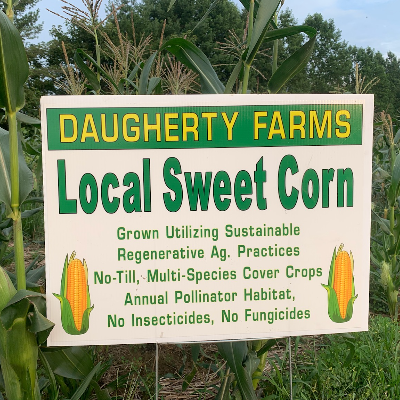
Daugherty Farms
Vendor
I am the District Conservationist with USDA-NRCS serving Coffee County. In 2013 I started the journey of implementing diverse cover crops into no-till row crop production in Coffee County. During this journey I would experiment with different cover crop species on my small 5 acre farm prior to introducing them to wide spread acreage across the county. This drove a passion that I wanted to start pushing the envelope in the management of high biomass regenerative row crop systems. Starting in 2015 I transitioned the acreage from a corn and soybean rotation into primarily devoted to the production of sweet corn for local fresh market consumers. In addition to sweet corn we grow okra and sunflowers. This transition happened primarily to get my two sons of 11 and 15 currently involved in agriculture and regenerative practices.
The planning of the sweet corn crop starts in late August and early September the prior year where a diverse multi species cover crop is drilled. The cover crop for the 2021 sweet corn crop consisted of a mixture of barley, cereal rye, triticale, bob oats, black oats, crimson clover, balansa clover, austrian winter pea, yellow field pea, hairy vetch, flax, buckwheat, and diakon radish. This cover crop is allowed to grow until planting. All the sweet corn is then no till planted into standing green cover crop. Following planting a roller crimper is used to roll and crimp a flat mat of biomass. Following the crimper the cover crop will be terminated using a burn down herbicide mixture. I typically terminate the cover crop with a mixture of paraquat and dual. This will be the only herbicide application that the crop sees for weed control. The dense mat of roller crimped cover crop provides enough weed suppression that additional post herbicide applications are not needed as opposed to tilled or stand alone no till plantings which will require post herbicide applications. During planting have infurrow application capabilities on my planter. I use a liquid mixture of Calibrate, Pro Germ, Micro 500, and Access S in furrow to provide the P, K, Zn, and S requirements. This method of in furrow application drastically reduces the salt load on the soil and is much less detrimental to the soil biota. When corn is around V6-V8 in growth stage I will walk the rows with a back pack sprayer and will dribble liquid nitrogen along side the stalk for a top dress nitrogen application at a equivalent rate of 25 gallons per acre. This method additionally reduces the salt load on the soil. In addition to the sweet corn planting I will will plant pollinator habitat between linear blocks of corn annually to attract beneficial insects and pollinators to alleviate the pest pressure on the corn crop. These annually planted habitat strips will consist of a mixture of sunflowers, buckwheat, and millets. There is absolutely no tillage performed on our operation. We do not grow any round up ready or liberty link ready GMO hybrids. This year the varieties of sweet corn that we are producing are Ambrosia, American Dream, and Honey Select. We do not strive to be labeled organic but rather regenerative working with nature and farming in her image utilizing the best technology and applications possible to grow a quality and healthy product at the same time regenerating the soil resource.
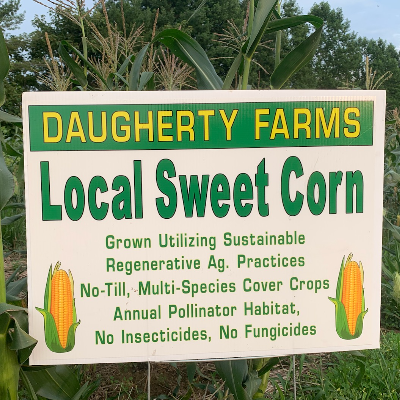
Soil Health and Regenerative Ag expert. Family farm consisting of wife and 2 sons
