Piedmont Permaculture LLC
Vendor
Since our beginnings in 2020, we have viewed Piedmont Permaculture as an opportunity to connect directly with our community through responsible food production. By providing natural products at an affordable cost, and implementing regenerative agricultural practices, we aim to positively impact our local food systems more and more each growing season.
In order to facilitate its transition towards a more stable, productive landscape permaculture techniques are used in the planning of every aspect of our farm; all the while creating healthier soils with increased biodiversity. We prize the ecological complexity of Virginia’s Piedmont region and recognize the opportunity to learn from its natural landscapes.
Through incorporating local flora, fauna, and fungi, we are modeling an agriculturally productive system that aspires to mirror native habitats.
Our intent is to work with, rather than against, the natural world.
Integrated Pest Management Extended Growing Season Use Only Organic Materials Permaculture Design Perennial Crops Holistic Management Crop Rotation Cover Crops No Till Uncultivated Landscape Management Polyculture Design Thermal Composting
We utilize permaculture and regenerative agriculture techniques to grow low-impact produce that is free of pesticides and other chemicals. Our production efforts are centered around good soil management to generate a healthy soil biome not commonly found in conventional agriculture models.
We integrate a wide range of flora, fauna, and fungi to increase yields while providing habitat and food for natives species.
Honeybees are kept on site for pollination services and honey production.
Poultry and companion planting are used as part of our integrated pest management.
With a certification in permaculture design, we bring experience in implementing farm systems that reduce the need for external inputs and steer our market garden more towards mirroring the balance found in nature.
We additionally hold a certification in wild mushroom foraging and hope to contribute locally foraged fungi to the collection of products available at market.
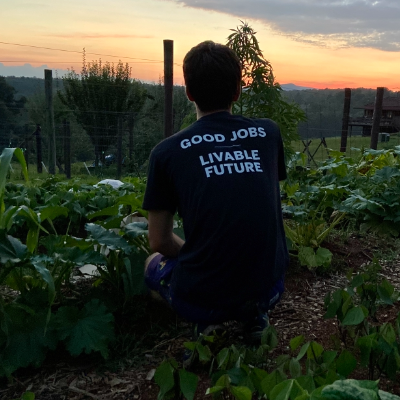
Growing up in Rappahannock County, I remember spending countless hours admiring the ecological beauty present in our outdoor spaces. I always had a keen interest in food production and, as a younger child with less of a grasp on what that entailed, watching things grow. One year, in elementary school, I remember growing my own patch of pumpkins. I’d dedicate many evenings after school to water and weed and monitor their growth.
That appreciation for agriculture continued and when I was fourteen I started my adventure in beekeeping. I’ve had bees nearly every year since then. As of 2021 I’ll be managing 11 colonies.
After graduating high school in 2018, I spent nearly a year backpacking South America on a shoestring. I visited Ecuador, Peru, Chile, Argentina, and Brazil. To save money, I volunteered in exchange for a place to stay through programs such as WWOOF (World Wide Opportunities on Organic Farms) and eventually fell in love with a permaculture-minded farm in southern Chile’s Patagonia region. I remained there for three months and learned much about small-scale farming principles and organic vegetable production. The farm was on about five acres and had three 100-foot hoop houses, many vegetable beds, bees, a herd of goats, and an essential oil distillation facility.
In Brazil, I worked with apiculturists in managing and transporting africanized honey bees to a semi-arid plateau to benefit from a short wet season. I also assisted with catching and boxing swarms.
These experiences cemented my passion for agriculture and local-based food production.
After returning from South America, I continued maintaining a personal garden and began implementing some of the things I had learned while away.
In 2020, my partner and I started Piedmont Permaculture so that we could sell some of the surplus produce and honey to local retailers. In the midst of the pandemic and a busy and successful production year, I began to consider the possibility of switching full-time to farming. I spent last year expanding beds and planning for a CSA program we’re preparing to begin in May 2021.
We are excited to help represent a generation of young farmers and look forward to joining the Warrenton Farmer’s Market crew to serve our local community.

Around the web